Wall diving in Adriatic and Kornati
Last updated: July 17, 2026
If we are heading to a wall in Kornati or along the Murter coast, this is what we usually tell people on the boat. Walls here are not tropical coral — they are limestone drops into deep blue, with sponges, gorgonians, and fish in the cracks. Stunning when the sea is calm; a bit more “pay attention” than a shallow reef. Nothing scary if you know what to expect.
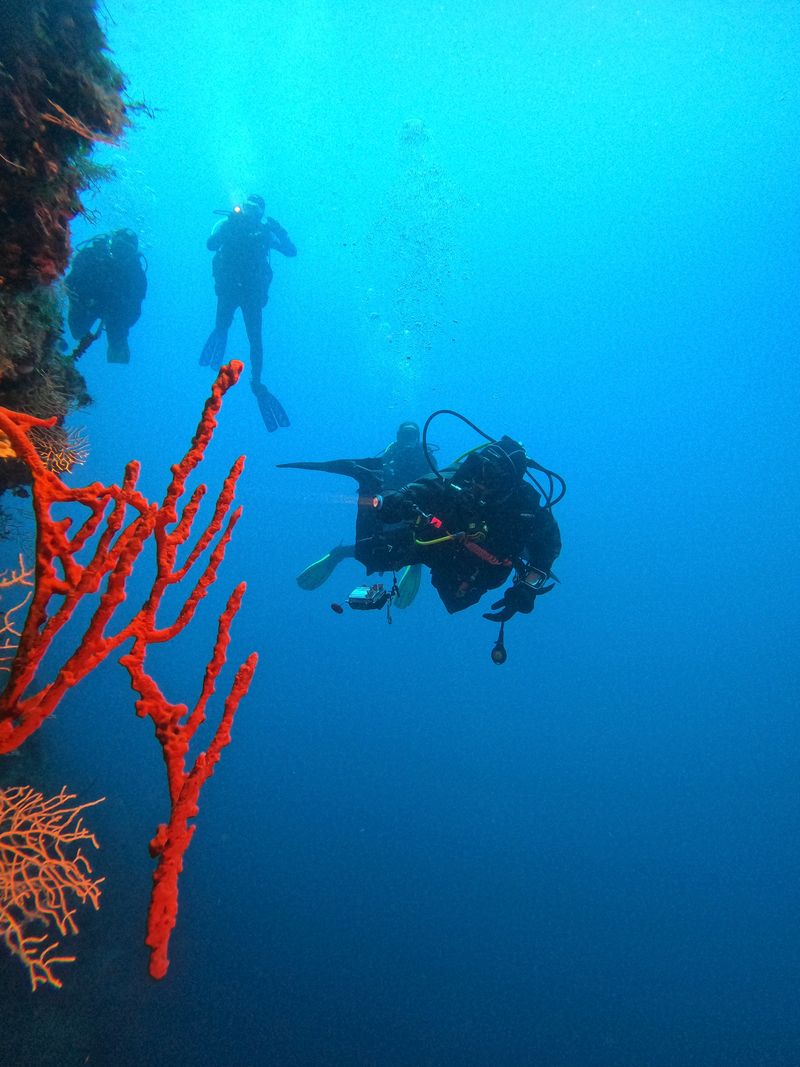
Picture this: rock on one side, open blue on the other. The wall drops away beneath you — sometimes gently, sometimes straight down. The rock is limestone, with plenty of cracks and small overhangs — fish often hide in them, or you'll find life that doesn't like direct sunlight. When it's clear, you can see the whole underwater landscape.
Most wall dives either start on a shallow plateau or continue down from one — not always a sheer drop from the surface.
Gorgonians and sponges are usually deeper; schools of fish are often in the shallows too. You might also spot nudibranchs, scorpionfish, and octopus in the cracks. Wall on one side, open blue on the other — it can feel dramatic at first until you pick a simple reference: the wall line, your buddy, the guide.
In Kornati the water is often clear enough that the whole wall opens up in front of you. That's what sticks.
Current — Hard to predict — what you see on the surface is not always what you get at depth. Strong current is rare here; we pick the site for weather, not current.
Temperature — Surface might be 24 °C in summer; at depth it is often around 16 °C all season. You will hit a thermocline — sudden chill, sometimes a slight change in how the water looks. Normal here; just be ready for it.
The rock looks bare — it isn't — Sponges and gorgonians grow slowly. Stay slightly off the wall, watch your fins — good buoyancy takes care of the rest.
Start and finish on the plateau. We usually begin the dive on that plateau and plan to end there too. It is a comfortable depth to start from, and the same spot works well for the safety stop.
Stay with the wall. We swim along the face, not straight out over the blue. The wall is your reference — depth, direction, where the group is. Cutting across open water rarely saves time and makes it easy to lose the site or each other.
If you are in the blue — crossing to the boat, ascending away from the wall — watch your computer. Without the wall beside you, depth creeps up quietly. Check depth, time, and gas often.
Torch — Bring one on wall dives — worth it. Colours fade with depth; a light brings the overhangs and cracks to life. We mention this in the morning briefing too.
Not every wall is a deep drop — many have nice overhangs and ledges at shallower depth that are worth the dive on their own. Where the wall does keep going below you, you still do not need to follow it down. Staying shallow on a deep wall is normal and usually the best plan.
We end the dive on time and gas, not on “seeing everything.” Hang a few metres off the wall so you are not scraping rock and you have room to adjust trim.
Never done a wall? Tell us when you book or at check-in. We will match you to a suitable site and keep the group size sensible — typically four to six divers per guide, same as our other boat dives.
Planning your first boat trip with us? See our What to Expect guide for how a diving day works, browse our dive sites, or contact us to book.